Your hair is a readout of what's going on inside. Kidney problems and hair loss go together far more than people think: in kidney disease, hair changes show up in more than half of patients, and the worse the kidneys, the worse the hair. It isn't one magic pathway. When your kidneys stop clearing properly, toxins build up, inflammation rises, blood carries less oxygen and your thyroid slows down, and your follicles are the first thing to pay for it. Fix the load and the follicles get their chance back.
Landmarks
- Uremic toxins
- Waste your kidneys are supposed to clear. When they don't, it builds up in your blood and inflames everything, follicles included.
- EPO
- Erythropoietin, the hormone your kidneys make to tell your bone marrow to build red blood cells. Less EPO, less oxygen.
- Anagen
- The growing phase of a hair. The longer a hair stays in anagen, the longer and thicker it gets.
- Telogen
- The resting phase, after which the hair falls out. Stress pushes more hairs into telogen at once, which is shedding.
- T3 and T4
- Your thyroid hormones. T4 is the storage form, T3 the active one. Kidney disease drags T3 down.
Key points
- Hair changes were found in more than half of kidney patients, and were less common in those on dialysis (PMID 24362662).
- In 365 kidney patients not yet on dialysis, hair problems were the second most common skin finding (PMID 27030004).
- Hair loss correlated strongly with how severe the kidney failure was (PMID 28128158).
- A third of kidney patients had sparse scalp hair, and more had dull, lifeless hair (PMID 29441293).
- Hair loss is frequent in long-term dialysis, with leftover toxins and a slow thyroid as the likely drivers (PMID 6495898).
- Thyroid hormones directly keep hair follicles in their growing phase (PMID 18728176).
- Low T3 is the most common thyroid finding in kidney disease (PMID 24829799).
- An imbalanced gut feeds the uremic toxins that inflame the body in kidney disease (PMID 39795549).
Can kidney problems cause hair loss?
Yes, and it's common. In one group of kidney patients, 59% had hair changes (PMID 24362662). In 365 patients who weren't on dialysis yet, hair problems were the second most common thing doctors found on their skin (PMID 27030004). In another group, a third had sparse scalp hair and more had dull, lifeless hair (PMID 29441293).
And it scales with the damage. In kidney failure, hair loss correlated strongly with how severe the failure was (PMID 28128158). Worse kidneys, worse hair.
The telling detail: patients whose blood was being cleaned by dialysis had fewer hair problems than those who weren't on it yet (PMID 24362662). Get the junk out of the blood and the hair does better.
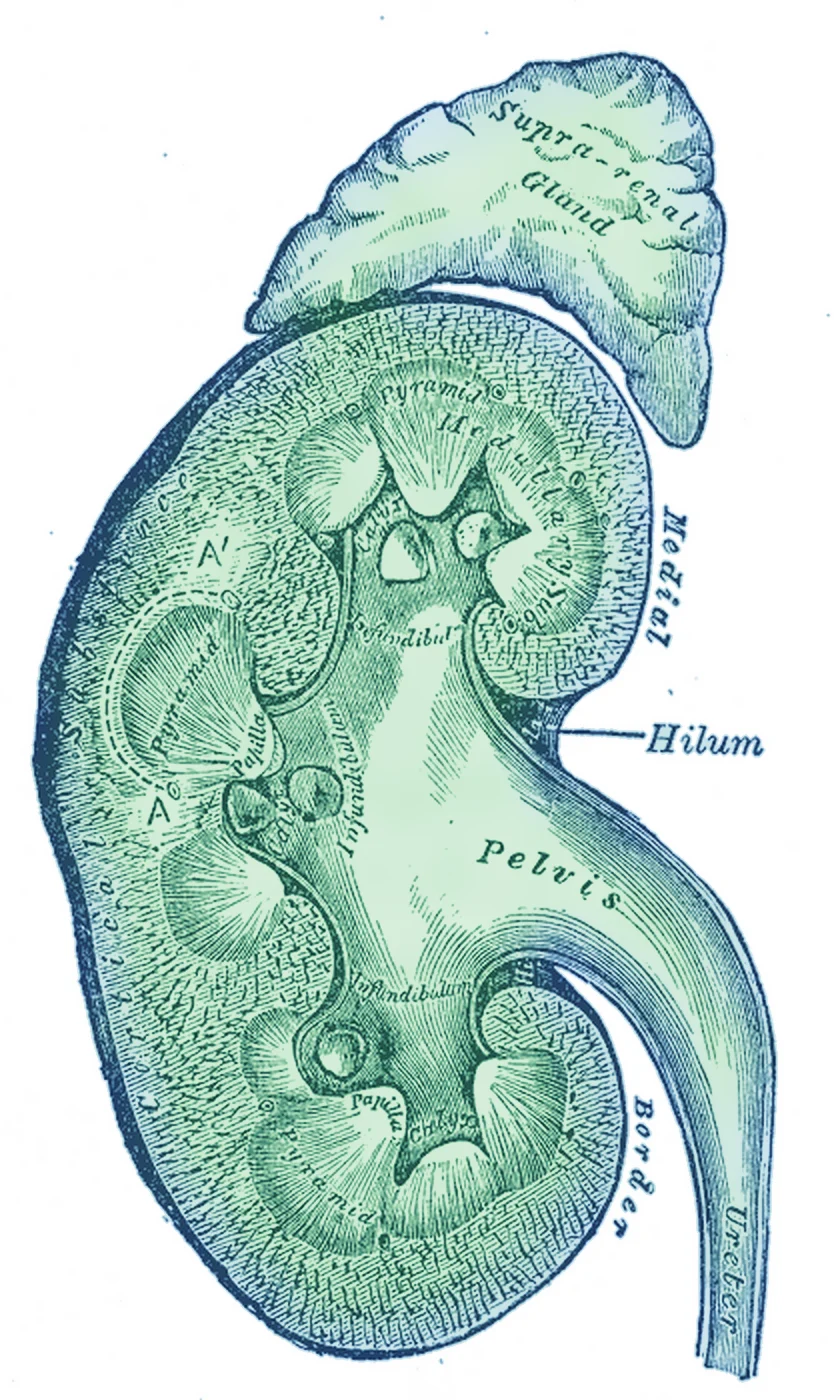
01 / 06 · Adrenal
The gland sitting on top of each kidney. It makes DHEA, the building block for your androgens, and your stress hormones.
Vertical section of a kidney, Gray's Anatomy, hand-tinted. Tap a part to see what it does for your hair.
Why weak kidneys thin your hair
Kidneys don't control hair directly. They control the blood your hair grows from. When they slow down, four things hit your follicles at once:
Core · the kidney
Edge · your hair
01 / 06 · Kidney
The filter falls behind
Hair loss tracks how bad the kidney failure is (PMID 28128158).
The kidney at the core, your hair at the edge. Tap a ring to follow the chain.
- Toxins build up. Waste stays in your blood and drives inflammation and oxidative stress through your whole body, follicles included.
- Less oxygen. Your kidneys make EPO, the signal for red blood cells. Weak kidneys, less EPO, anemia. The cells at the base of a hair divide faster than almost anything else in your body, so they feel it first.
- Your thyroid slows. Kidney disease drags down active thyroid hormone (PMID 24829799), and thyroid hormone is what keeps a hair growing.
- Minerals go off. Kidneys balance your calcium and phosphate. When that balance slips, the environment around the follicle changes with it.
What your hair follicle actually needs
Every hair grows from a bulb at the bottom of a tiny pocket in your skin. The bulb sits on a knot of blood vessels, and the cells in it divide nonstop to push the hair up. That makes it one of the most demanding tissues you have: it needs clean blood, plenty of oxygen and a steady thyroid signal, every single day.
Thyroid hormone works right on the follicle. When researchers added it to living human hair follicles, the growing cells at the base multiplied faster and the hairs stayed in their growing phase longer (PMID 18728176). Too little of it and hairs quit early and shed.
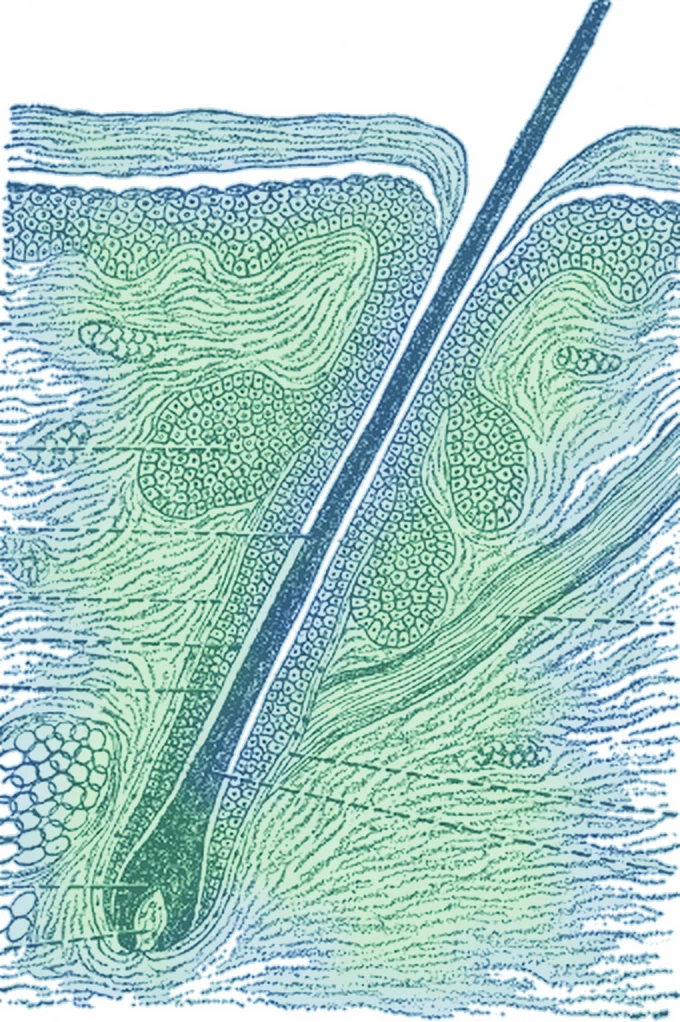
01 / 06 · Shaft
The hair you see. It's dead keratin, a record of how the follicle was doing while it grew.
Section of skin with a hair in its follicle, Gray's Anatomy, hand-tinted. Tap a part.
Thyroid, kidneys and hair
The thyroid and kidneys drag each other down. A slow thyroid lowers kidney filtering, and kidney disease disturbs thyroid hormone in turn (PMID 27864708). In kidney patients, low T3 is the most common thyroid finding, followed by a mildly underactive thyroid (PMID 24829799).
That's the double hit for hair. Doctors watching long-term dialysis patients noticed how often they lost hair, and pointed to toxins that weren't being cleared plus a slow thyroid (PMID 6495898).
Selenium matters here too. Your body needs it to turn T4 into active T3, and blood selenium is often low in kidney disease (PMID 23023721). Raw eggs, raw meat and organs carry it whole.
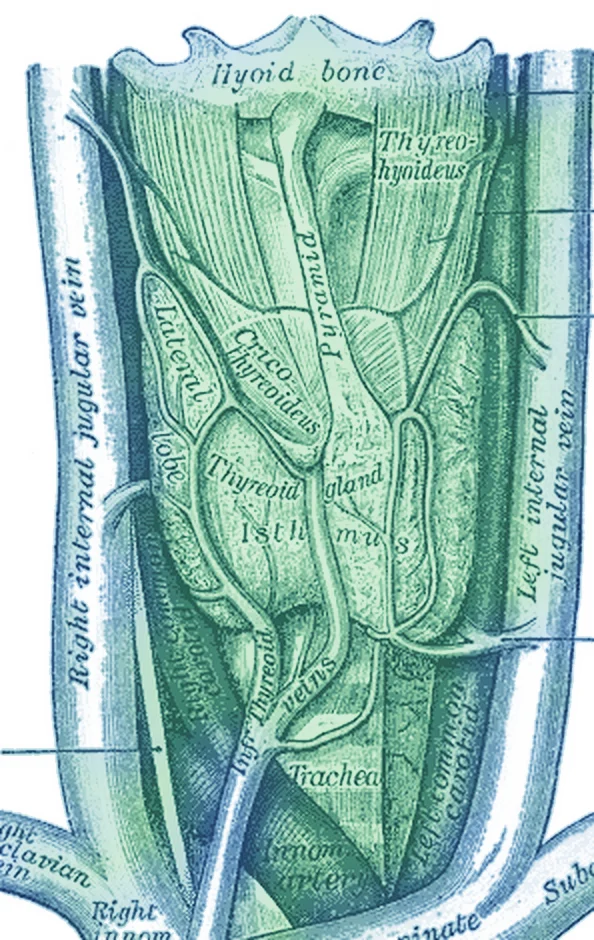
01 / 05 · Hyoid
The small bone at the top of your throat, just above the thyroid.
The thyroid gland and its vessels, Gray's Anatomy, hand-tinted. Tap a part.
Where the toxins come from: the gut-kidney link
A lot of the toxins that pile up when kidneys fall behind are made in your gut. When the balance of gut bacteria goes wrong, they produce compounds like indoxyl sulfate and p-cresyl sulfate that damage the kidneys further and inflame the whole body (PMID 39795549). It's a loop: bad gut, more toxins, harder-working kidneys, worse hair.
That's why the food side matters so much. Aajonus built his whole diet around feeding the good bacteria with raw food, and raw fermented milk carries them in live. The case for it is in raw milk for looksmaxxing.
What about DHT?
Pattern baldness was the most common hair finding in kidney patients (PMID 27030004). People see that and blame DHT. But these are follicles already running on dirty blood, low oxygen and low thyroid. Stressed follicles are what give up first.
Don't block DHT. It's testosterone through 5-alpha-reductase, and after puberty your bones still thicken under it: jaw, brow, frame. No finasteride. Fix what's stressing the follicle instead.
@bruceisprimal talked about it.
The sun helps both sides: it raises T and opens up blood flow through the skin. See sunlight for testosterone.
What Aajonus said about hair loss
Aajonus's view was blunt: toxins cause hair loss. He said people don't want you to know it's industrial pollution that causes your hair loss, and that the body will build minerals into the follicle, which causes all hair loss.
On thyroid he went further than the studies. He said thyroid has nothing to do with hair, and that when thyroid hormone does stop some balding, it's because hormones are mostly fat and bind the toxins that cause the hair loss. The studies above say thyroid hormone does act on the follicle. Either way you end up in the same place: cut the toxic load.
For the kidneys specifically, he said eating no-salt raw cheese or clay helps draw poisons from the blood into the intestines rather than into the liver, kidneys and brain. He warned that when you gulp water most of it goes right into the kidney without feeding your cells. And he said no one developed kidney stones on his diet, because uric acids don't collect when eating raw meat.
Aajonus's peppercorn scalp remedy
Aajonus used a peppercorn mix on his own scalp, after chemo and radiation thinned his hair, and said he saw it thicken within a few weeks (Hair Loss Remedy).
- Blend 2 tablespoons each of black and white peppercorns into a powder.
- Add 3 oz of rain water, or distilled water not from a plastic bottle, and blend for a minute.
- Let it stand in a dark cupboard for a day.
- Dip your fingers in and rub it into a clean scalp. Leave it until your next wash.
- Every third day, since pepper can irritate.
Raw food for your hair and kidneys
Hair is protein built on a fat-coated scaffold, and your hormones are mostly fat. So the food side is raw animal fat and raw animal protein, and nothing that adds to the toxic load. Aajonus was strict and we're stricter: every animal food raw. Never cooked, never pasteurised, never frozen.
Raw eggs, raw meat and organs for protein and selenium. Raw unsalted butter and raw cream for fat. No-salt raw cheese to pull poisons out through the gut. Warm raw milk and raw fermented dairy for the good bacteria. Fresh raw vegetable juice. No salt, no seed oils, no grains, no supplements, no protein powder.
How long does it take to get hair back?
Hair works on a slow clock. A hair that has already gone into its resting phase will still fall out, and a new one takes months to grow in. So judge it in seasons, not weeks.
Shedding usually settles first, then thickness comes back as new hairs stay in their growing phase longer. Aajonus said he saw the peppercorn mix thicken his thinned hair within a few weeks.
How to protect your hair when your kidneys are the problem
Take the load off your kidneys, feed the follicle.
- Eat raw fat and protein daily: raw eggs, raw meat, organs, raw unsalted butter and raw cream.
- Eat a little no-salt raw cheese to pull poisons out through the gut instead of the kidneys.
- Sip water slowly through the day. Don't chug it.
- Drink warm raw milk or raw fermented dairy for the gut bacteria.
- Cut salt, seed oils, grains, processed sugar and supplements.
- Get sun on bare skin for T and blood flow.
- Use Aajonus's peppercorn mix on your scalp every third day.
- Don't touch finasteride. Fix the load, not the enzyme.
Kidneys and hair, side by side
What was found, and the study behind each one.
| What | Finding | Source |
|---|---|---|
| How common | Hair changes in more than half of kidney patients | PMID 24362662 |
| Before dialysis | Hair problems the second most common skin finding | PMID 27030004 |
| Severity | Hair loss tracks how bad the kidney failure is | PMID 28128158 |
| Thinning | A third had sparse scalp hair, more had dull hair | PMID 29441293 |
| Dialysis | Frequent hair loss, toxins and slow thyroid blamed | PMID 6495898 |
| Thyroid on the follicle | Keeps hairs growing longer | PMID 18728176 |
| Thyroid in kidney disease | Low T3 most common | PMID 24829799 |
| Gut | Imbalanced gut feeds the uremic toxins | PMID 39795549 |
| Selenium | Often low in kidney disease | PMID 23023721 |
Frequently asked
Yes. Hair changes show up in more than half of kidney patients (PMID 24362662), and hair loss tracks how severe the kidney failure is (PMID 28128158).