The labiomental angle is the bend between your lower lip and chin. One segment follows the lower lip into the deepest point of the labiomental fold. The other follows that fold toward soft tissue pogonion. A smaller angle creates a deeper, sharper fold. A larger angle creates a flatter transition. The measurement reflects chin projection, lower lip position, lower incisor support, vertical lower face pattern, and mentalis activity. Never read it as a chin variable alone.
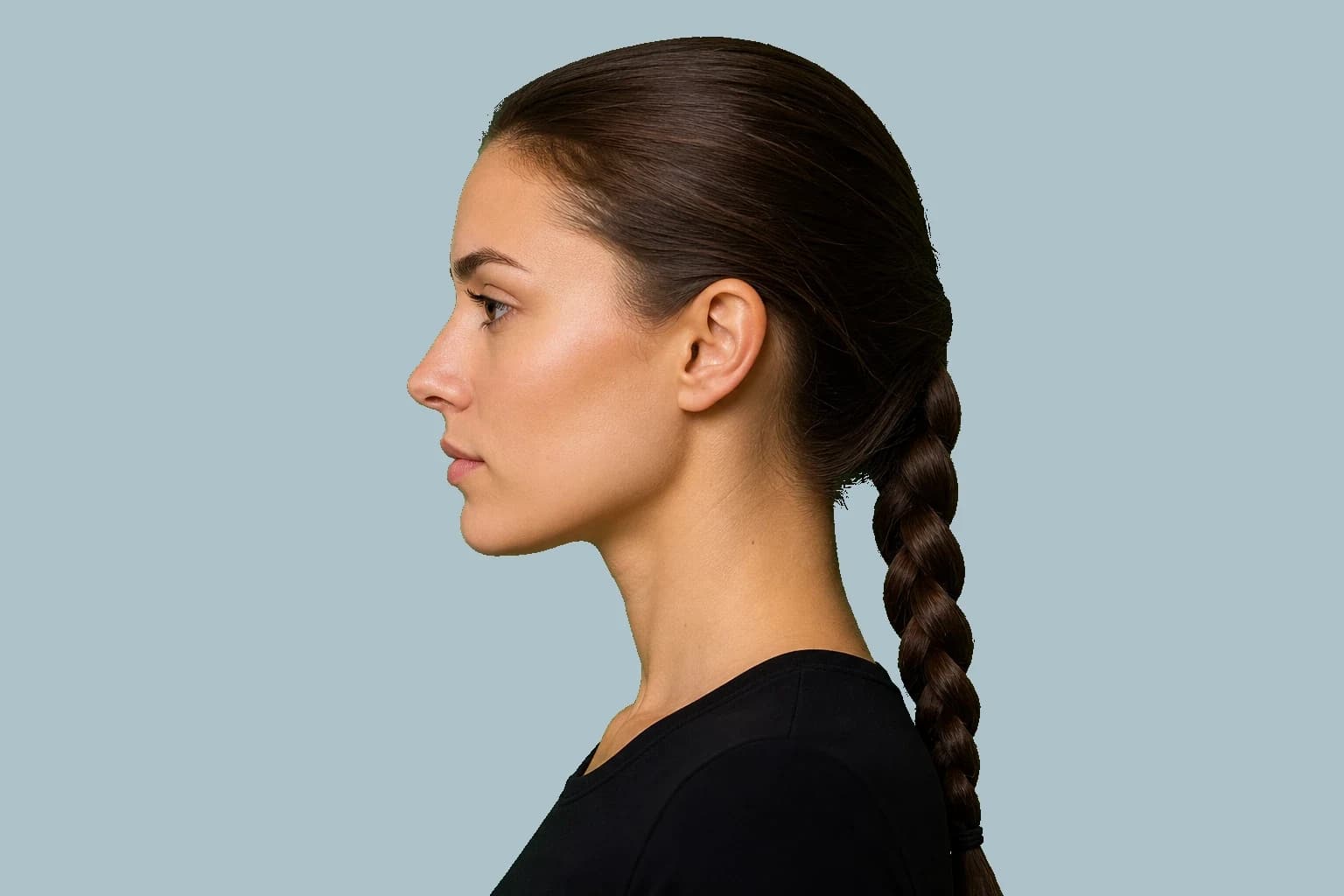
Landmarks
- Labiomental foldSi
- The deepest soft tissue point between lower lip and chin, also called the mentolabial sulcus.
- Labrale inferiusLi
- The most anterior point of the lower lip vermilion.
- Soft tissue pogonionPg prime
- The most anterior point of the soft tissue chin.
- Mentalis
- The paired chin muscle that can raise the lower lip and wrinkle or deepen the chin region when active.
How is the labiomental angle measured?
Mark the lower lip point, the deepest point of the labiomental fold, and soft tissue pogonion. Draw one tangent down the lower lip into the fold and a second from the fold along the chin contour. The internal angle at the fold is the labiomental angle.
Some methods use tangents rather than direct landmark lines. This matters when the lower lip or chin is strongly curved. State the construction and keep it consistent across comparisons.
The lips must be relaxed. Active mentalis contraction can deepen the fold, raise the lower lip, and sharply change the angle without structural change.
Li Si Pg
Common landmark sequence
About 110° to 130°
Broad descriptive adult zone
Muscle sensitive
Mentalis tension changes the fold
What creates a deep or flat fold?
A projected chin and forward lower lip can create a deep fold between two prominent structures. A retrusive chin can also create a sharp bend when the lip remains forward. A flatter chin and lip relation opens the angle.
Vertical lower face pattern matters. A short lower face with strong chin projection often has a more compact fold, while a long lower face can stretch the transition. These are tendencies, not rules.
What profile studies measure
A study in young Pakistani adults compared photographic and cephalometric evaluation of the nasolabial and labiomental angles, demonstrating both aesthetic relevance and method dependence (PMID 35124924).
A separate study introduced the lower lip to chin prominence angle to analyse chin prominence in direct relation to the lower lip (PMID 31331858). Use that construction when the labiomental angle alone cannot separate lip and chin contributions.
How teeth, muscle, and treatment affect it
Orthodontic tooth movement can alter lower lip support and the lower face profile (PMID 35461792). Chin filler, genioplasty, or jaw movement changes the other arm of the angle. Mentalis contraction can change both the fold and chin surface temporarily.
A before and after angle needs matched lip rest and an explanation of which anatomical component changed.
How to avoid a false deep fold
Ask for relaxed lips and no chin strain. If the lips cannot close without effort, document that state rather than forcing closure. Use a true side profile with the entire lower lip and chin visible.
Soft shadow can define the fold, but hard side light can make it look deeper than it is. Use even lighting for measurement.
How Shastra reads the labiomental angle
Shastra estimates the lower lip to chin fold angle and reads it beside chin projection, lower lip position, chin height, and lower face balance. It does not reward the deepest possible fold.
A tense mentalis or parted lips can reduce profile confidence. Repeat the scan with a genuinely neutral expression rather than trying to correct the number through expression.
Frequently Asked Questions
The side profile angle at the deepest fold between your lower lip and chin.
Shastra
Explore your facial proportions
Upload a front and side photo to see these measurements on your own face.

- Symmetry
- fWHR
- Canthal tilt
- Facial thirds
- Gonial angle
- E-line
- Phi ratio