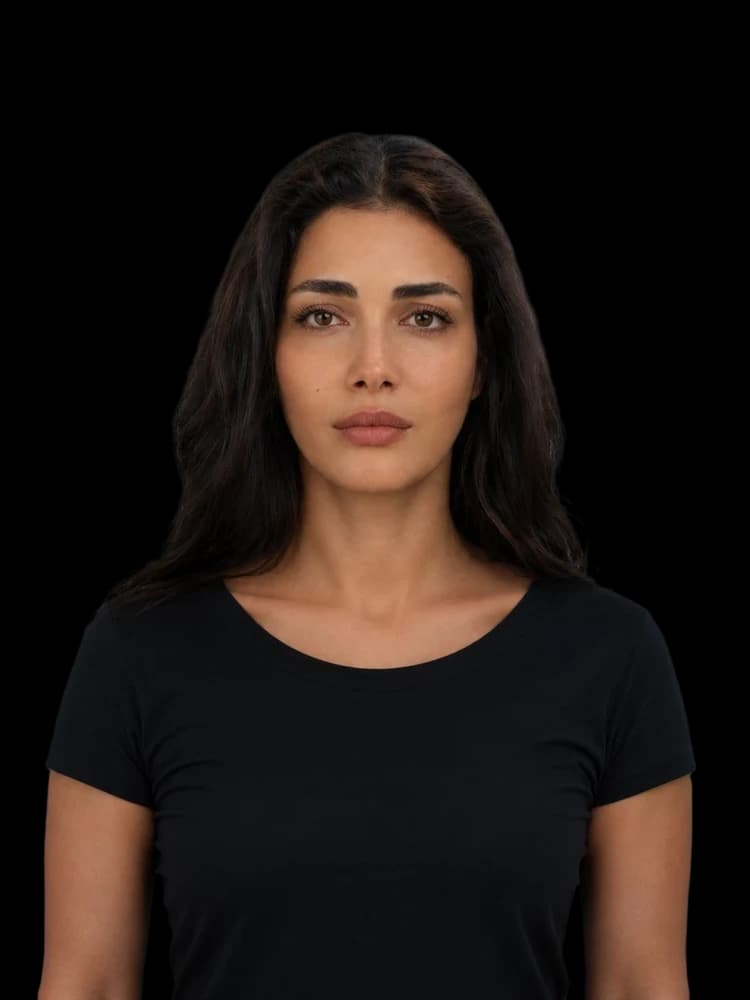
The gonial angle is the angle at the jaw corner, where the upright ramus meets the body of the mandible. A common radiographic construction uses articulare, gonion and menton (Ar–Go–Me). Adult values are often described around 120–130°, but the sample and measurement method matter; this is not a universal ideal. A smaller angle describes a sharper corner, a larger angle a more open corner. A photograph shows the overlying jawline, while jaw width measures the distance between the two corners.
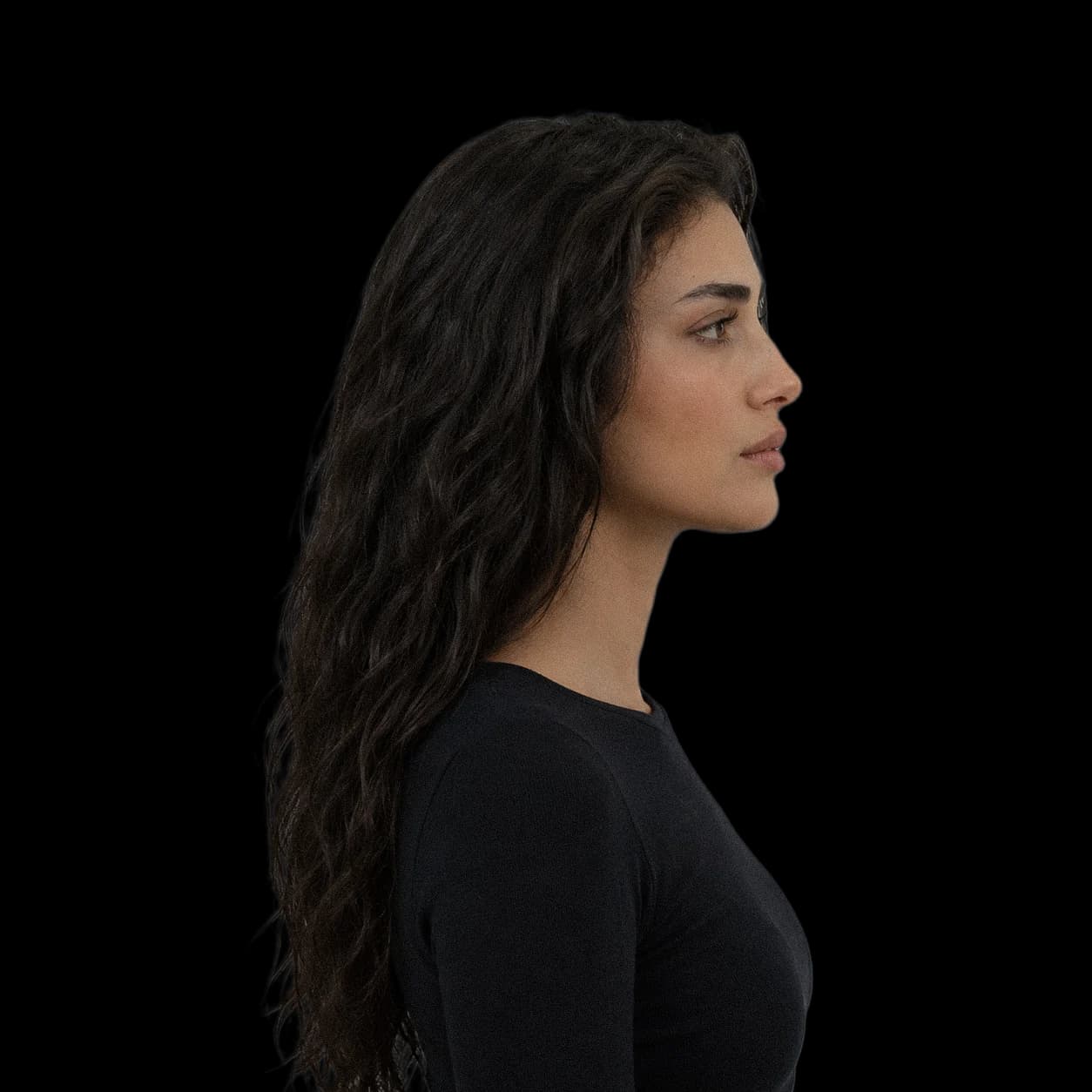
Landmarks
- Gonial angle
- The angle at the corner of the mandible, between the ramus and the body. Conventionally traced articulare–gonion–menton on a lateral film.
- Gonion (Go)
- The corner point itself: the most posterior-inferior point of the mandibular angle, where the ramus turns into the body.
- Articulare (Ar)
- The point where the posterior border of the ramus crosses the cranial base on a lateral radiograph. The upper end of the ramus line.
- Menton (Me)
- The lowest point of the bony chin. The forward end of the body line.
- Antegonial notch
- The concavity just forward of gonion on the lower border. The antegonial angle and depth are separate measurements that change with remodelling when the gonial angle does not.
- Low-angle / high-angle
- Shorthand for the vertical facial pattern. Low-angle is the horizontal, brachyfacial, squarer-cornered face; high-angle is the vertical, dolichofacial, more sloped face.
How is the gonial angle measured?
The gonial angle is read in profile, from the side. You need three landmarks. Articulare (Ar) is where the posterior border of the ramus crosses the cranial base, near the ear. Gonion (Go) is the corner itself, the most posterior-inferior point of the mandibular angle. Menton (Me) is the lowest point of the chin. Draw the ramus line down from Ar to Go, draw the body line forward from Go to Me, and the angle between them at Go is the gonial angle. Jaw width, by contrast, is a front-view measurement between the two gonion points (what jaw width is). Same landmark, different question, different view.
The instrument changes the number. The angle is classically traced on a lateral cephalogram. It is also routinely measured on a panoramic radiograph (OPG), where each side can be read separately, which is why forensic and orthodontic papers so often use OPGs (PMID 38646405, PMID 41164515). Those two are not interchangeable readouts. Panoramic imaging distorts, and transverse mandibular values measured on OPG are magnified relative to the cleaner CBCT read (PMID 41303135). A gonial angle quoted without the modality attached is an incomplete number.
Soft tissue is the other trap. What you see in a photograph is the jawline, which is bone plus masseter plus fat plus skin. The gonial angle is a bony angle underneath all of that. A thick masseter fills in the corner and makes the jawline look sharper than the underlying angle is. A low body-fat face shows more of the true corner. Neither one changed the Ar–Go–Me tracing. If you are estimating your gonial angle from a phone photo, you are estimating a soft-tissue silhouette at an unknown focal length and head rotation, not measuring a cephalometric angle.
- Articulare (Ar). Upper end of the ramus line, where the posterior ramus meets the cranial base.
- Gonion (Go). The vertex. The most posterior-inferior point of the corner.
- Menton (Me). Lowest point of the chin. The forward end of the body line.
- Plane. Profile, not front. Front-view jaw measurement is bigonial width (jaw width).
- Instrument. Lateral cephalogram is the classical trace; OPG allows left and right separately but distorts (PMID 41303135).
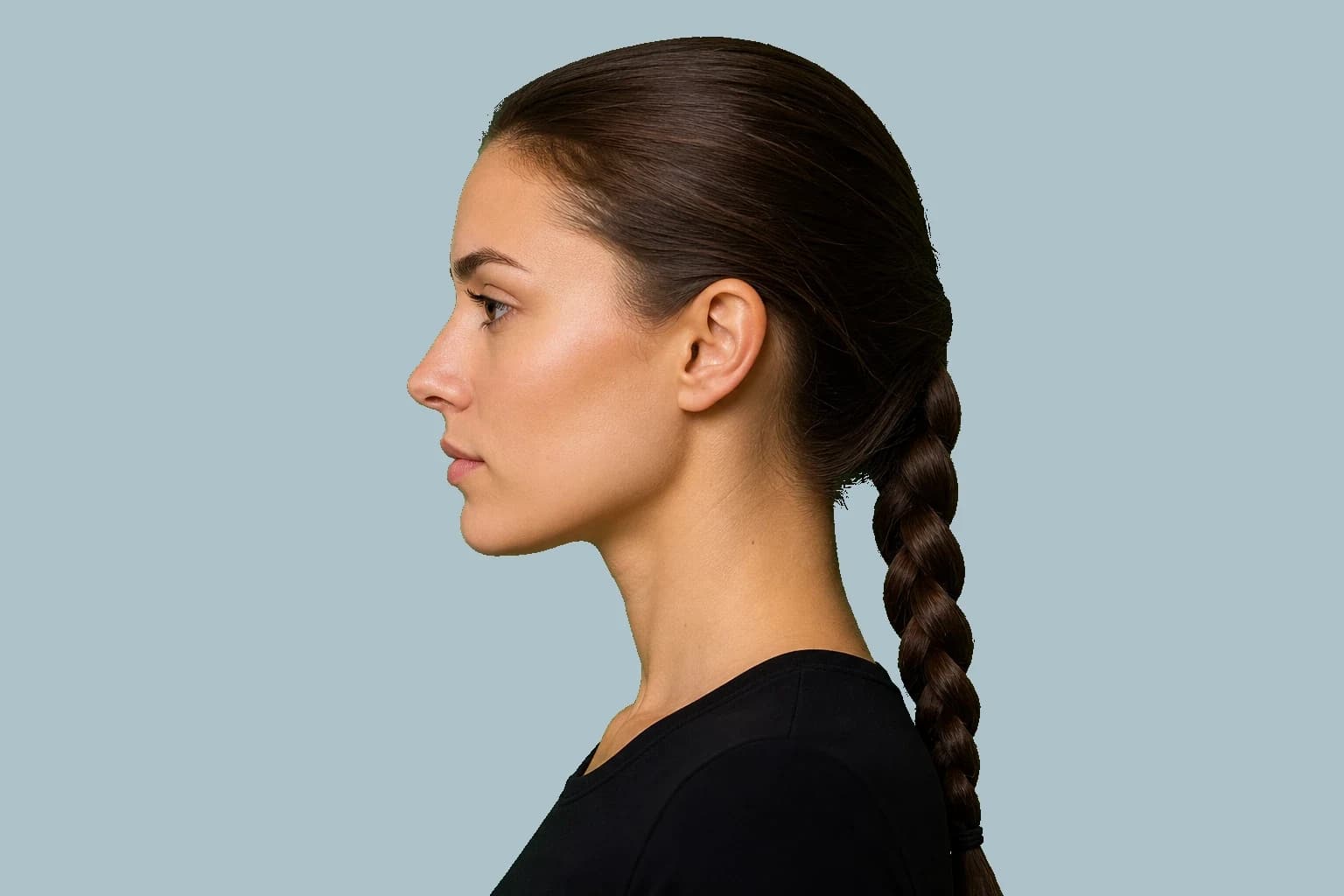
Why does the gonial angle matter?
The gonial angle is a shorthand for vertical facial pattern. It travels with the mandibular plane angle. A face with a small gonial angle tends to be the low-angle, horizontal, brachyfacial pattern: a squarer corner, a more closed bite geometry, a deeper lower face. A face with a large gonial angle tends toward the high-angle, vertical, dolichofacial pattern: a more open corner, a longer lower third, a jaw that slopes down from the ear instead of turning at it. This is why the angle keeps showing up as a variable in skeletal-type prediction models (PMID 25087172), and why cephalometric studies of altered growth environments report shifts in mandibular plane and Y-axis angles alongside it (PMID 22425033).
The reason it reads as masculine has nothing to do with the angle in isolation. A square lower third is produced by width at the corners plus a sharper corner plus masseter bulk on top of it. Those are three separate variables. A narrow mandible can carry a very acute gonial angle and still look thin from the front. A wide mandible can carry an obtuse angle and still look heavy. Online analysis collapses all three into one word, "jaw", and then argues about it. Reading them apart is the entire point of measuring.
What is a normal gonial angle?
A normal gonial angle is better treated as a band than an ideal. In adult clinical reading, roughly 120–130° is the common descriptive zone. Below about 120° reads sharper and lower-angle; above about 130° reads more open and high-angle. Reported values move with population, age band, imaging modality, and where the tracer put gonion. Treat the numbers as vocabulary for "square" and "sloped", not as a universal target.
A good gonial angle for a jawline depends on what surrounds it: bigonial width, chin projection, mandibular plane, body fat, and masseter thickness. A sharper corner can still look narrow if the mandible is narrow from the front. A wider jaw can still look strong with a more open angle. The angle is one readout, not the whole lower third.
People sometimes search for gonion angle when they mean gonial angle. Technically, gonion is the point at the mandibular corner. The gonial angle is the Ar–Go–Me angle measured at that point.
120–130°
Common adult band
Below ~120°
Reads square / low-angle
Above ~130°
Reads sloped / high-angle
Gonial angle by sex, age, and population
Sex differences in the gonial angle are real but small and inconsistent, which is the honest version of this section. Discriminant-function work using mandibular morphometrics on panoramic films has found the gonial and antegonial angles contributing to sex classification (PMID 38646405), and a digital-radiography analysis found significant sexual dimorphism once age was adjusted for, with both angles contributing positively to classification (PMID 42227786). Against that, a radiographic study of subadults found the gonial angle showed no significant gender variation and performed poorly for sex determination, while linear mandibular measurements did separate the sexes (PMID 35015609). Other mandibular work lands the same way: heights and widths carry the sex signal, angles carry less of it (PMID 41164515).
The takeaway is not that the angle means nothing. It is that linear dimensions are the stronger dimorphic signal than the corner angle is. That is consistent with what the width literature shows: sex and population shift the spans, and a single canonical number is a bad goal (PMID 16044298, PMID 20810561). If someone tells you a specific degree value is the male ideal, they are quoting one sample's mean as a law.
| Group | What the literature reports | Source |
|---|---|---|
| Adult men and women | Gonial and antegonial angles contribute to sex classification in discriminant models; dimorphism significant once age-adjusted | PMID 38646405, PMID 42227786 |
| Subadults | No significant gender variation in gonial angle; poor accuracy for sex determination, while linear measurements were greater in males | PMID 35015609 |
| Regional panoramic series | Condylar and coronoid ramus heights and widths carried the sex and age signal more than angular measures | PMID 41164515 |
| Adults across age | Antegonial angle and depth changed with age; gonial angle showed no significant change | PMID 15585810 |
| Edentulous adults | Whether the angle widens after tooth loss is disputed; studied against cortical thickness, residual body height, and duration of edentulism | PMID 15153856, PMID 22774938 |
| Population and method | Anthropometric spans vary by population; OPG magnifies transverse mandibular values relative to CBCT | PMID 16044298, PMID 41303135 |
The masseter sits on the corner
The corner is where the masseter inserts, so muscle and angle are correlated. Jaw-muscle volume measured against craniofacial form showed a negative correlation with the mandibular plane and gonial angle: bigger muscle, smaller angle (PMID 2715474). Ultrasound work points the same direction, with low-angle subjects showing significantly greater masseter thickness than normal- and high-angle subjects (PMID 30348502), and thickness differing across skeletal and dentofacial patterns generally (PMID 20930353, PMID 23649053). Superimposition of MR onto cephalograms found masseter inclination tracking skeletal parameters including the mandibular plane angle (PMID 16629478).
The direction of causation is not settled by a correlation, and this article is not going to pretend it is. What is worth knowing is that the relationship runs both ways in the record. Repeated botulinum toxin injection into the masseter removes load rather than adding it. It has been documented producing bony changes in adult humans (PMID 28670563), and the masseter's anatomy is treated as informative enough about underlying skeletal form to be used in facial reconstruction (PMID 20338704). The corner is a muscle attachment site, not an inert hinge.
Practically: masseteric bulk at the angle is a separate visual layer from the angle itself. Surgical literature on lower-face contouring treats them as distinct targets: angle reduction is a bone procedure, neurotoxin is a muscle procedure, and layperson ratings of the two differ (PMID 34636764). Landmark studies for angle reduction plan against both hard- and soft-tissue measurements for exactly that reason (PMID 39311286).

Does the gonial angle change with age?
The gonial angle is comparatively stable in adulthood, which surprises people who expect it to open with age. Panoramic evaluation of mandibular remodelling across adult age groups found the antegonial angle and antegonial depth changing while the gonial angle showed no significant change (PMID 15585810). The literature on tooth loss is genuinely mixed: work correlating gonial angle size with cortical thickness, residual body height, and duration of edentulism was set up specifically because prior reports conflicted on whether the angle widens after tooth loss (PMID 15153856). Panoramic series in denture wearers and in elderly dentate versus edentulous subjects have measured the angle alongside ramus and condylar height for the same reason (PMID 9250838, PMID 22774938), and mandibular morphology in low-bone-mass edentulous females has been evaluated the same way (PMID 17052644).
So the honest summary for adults: the cortex and the residual ridge change more reliably with age and tooth loss than the corner angle does. A visible change in your jawline over months is much more likely to be fat, water, masseter tone, beard, posture, or lens compression than a remodelled gonial angle.
What the gonial angle is not
Almost every argument about the gonial angle is actually an argument about a different measurement. Keeping them apart is most of the value of this page.
- Not jaw width. Bigonial width is the front-view span between the two gonion points (jaw width). A sharp corner can sit on a narrow mandible.
- Not the mandibular plane angle. Related and correlated, but that one is measured against a cranial reference plane, not at the corner.
- Not the antegonial angle. That is the notch forward of gonion, and it changes with remodelling when the gonial angle does not (PMID 15585810).
- Not the jawline. The visible silhouette is bone plus masseter plus fat plus skin. The angle is the bone underneath.
- Not a sex test. It failed as one in subadults and carries less signal than linear mandibular dimensions (PMID 35015609).
What is shown, and what is not
The gonial angle is Ar–Go–Me, read from the side, on bone. It describes how sharply the ramus turns into the body, it tracks the vertical facial pattern, and it correlates with masseter bulk. It is not jaw width, it is not the jawline you see in a mirror, and it is not a reliable sex marker on its own. Linear mandibular dimensions outperform it there (PMID 35015609). Read it against jaw width and the rest of the measurements series. Those bony reads sit inside facial dimorphism. How to actually train it is in how to improve facial dimorphism. This page defines the measurement. It does not prescribe anything.
Frequently Asked Questions
The gonial angle is the angle at the corner of the mandible, where the ramus running up to the ear meets the body running forward to the chin. It is conventionally traced articulare–gonion–menton on a lateral radiograph and describes how sharply the jaw turns at the corner.
Shastra
Explore your facial proportions
Upload a front and side photo to see these measurements on your own face.

- Symmetry
- fWHR
- Canthal tilt
- Facial thirds
- Gonial angle
- E-line
- Phi ratio