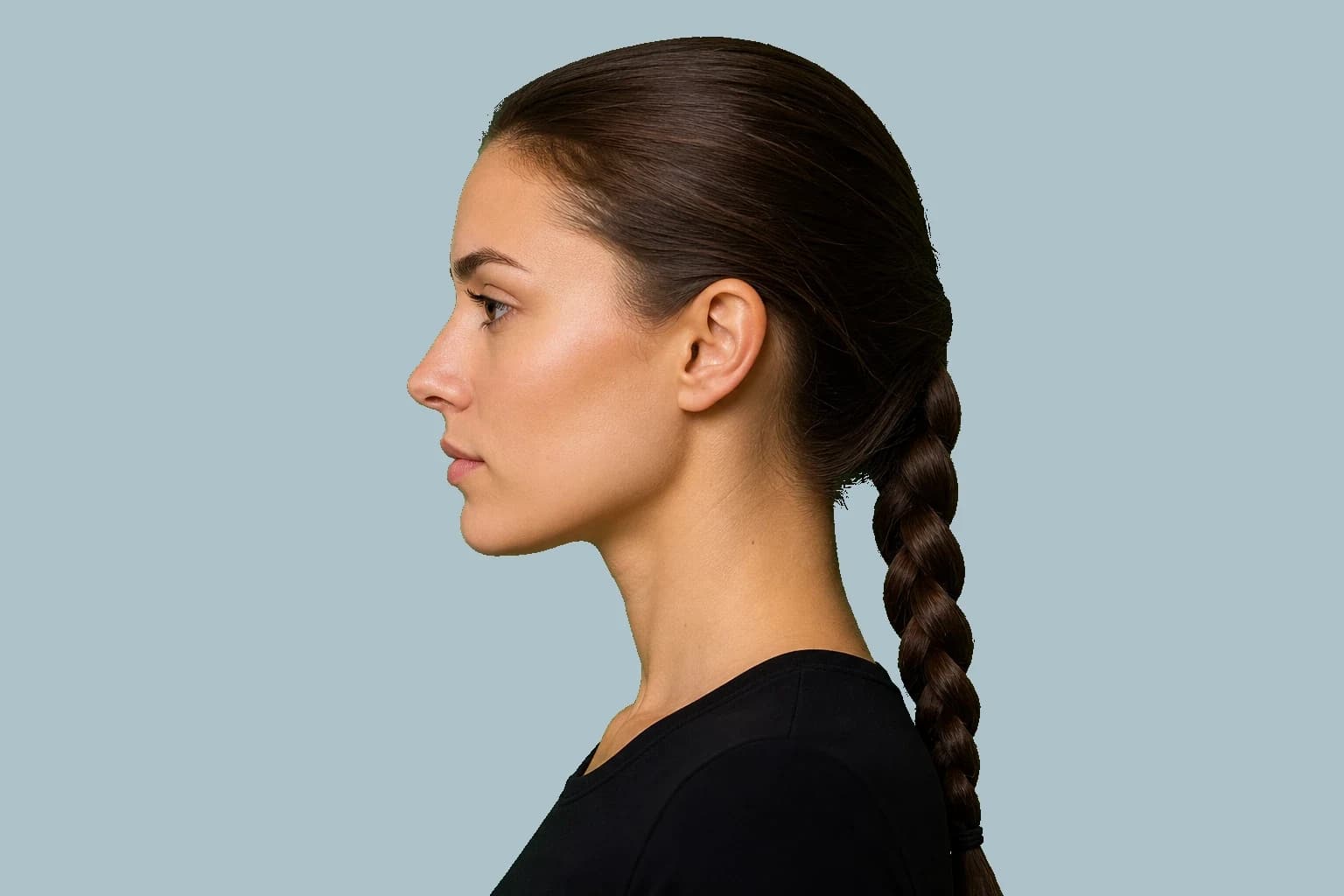
Lower face height is commonly measured on the surface from subnasale, beneath the nose, to soft tissue menton at the bottom of the chin. Stomion, where the lips meet, divides it into an upper-lip segment and a lower-lip-plus-chin segment. Specify whether your ratio compares those two segments or compares the entire lower face with total facial height. These are different calculations.

Landmarks
- SubnasaleSn
- The midline point where the columella meets the upper lip.
- StomionSto
- The midpoint of the relaxed lip seal.
- Soft tissue mentonMe prime
- The lowest midline point of the visible chin.
- Lower anterior facial height
- A skeletal cephalometric measure, often anterior nasal spine to menton, related to but not identical with the surface measure.
How is lower face height measured?
Mark subnasale, stomion and soft tissue menton on a frontal photograph with relaxed lips. Measure their vertical separations. The subnasale-to-stomion and stomion-to-menton distances should add to the full subnasale-to-menton distance when calculated along the same vertical axis.
For an illustrative 90-pixel lower face with 30 pixels above the lip seal and 60 below, the upper segment occupies 30/90, or 33.3%, and the lower occupies 60/90, or 66.7%. Their lower-to-upper ratio is 2.0. These describe the same example using different denominators.
A skeletal lower anterior facial height often uses anterior nasal spine and bony menton on imaging. Do not compare that distance directly with a surface photograph.
Sn to Me
Total soft tissue lower face height
About one third
Upper lip segment
About two thirds
Lower lip and chin segment
What makes the lower face long or short?
A visibly long lower face can reflect several components: upper-lip length, the lower-lip/chin segment, dental relationships and jaw orientation. Inspect the component distances before assigning the change to the chin.
Compare chin height and facial thirds. A photograph describes the surface proportions but cannot identify the skeletal or dental cause of a bite pattern.
What norms and preference studies show
A study of 49 young Japanese adults established sample-specific soft tissue cephalometric measurements and found sex differences in lower-face length and tissue thickness. Its values differed from an existing reference framework (PMID 23099223).
An experiment used altered photographs of one Asian man, rated by 66 people, to vary lower facial height and incisor inclination. Ratings depended on the combination and on whether the image showed a smile. This is a preference experiment using one face, not a universal optimum (PMID 34635397).
A retrospective analysis of 50 surgical patients tested several golden-ratio relationships. Only the measured lower-third proportion moved significantly toward that ratio after treatment. It did not establish a universal one-third/two-thirds target or measure whether that fraction guarantees attractiveness (PMID 21187759).
How aging changes vertical proportions
A longitudinal study compared 21 people at approximately 17 and 61 years of age. It found changes in facial height, teeth and soft tissue, with differences between sexes and tooth-loss groups. Its small sample shows why a later measurement needs age and dental context (PMID 34644780).
A short-term change in a photograph should first be checked against posture, lip position and measurement error. Long-term observations do not prove that a particular exercise caused growth.
How to photograph lower face height
Keep the face and camera level, include the whole chin and allow the lips to rest naturally. If the lips do not meet comfortably, record that rather than forcing a seal to create a stomion measurement.
Take several images with the same framing. A smile changes the upper-lip segment, while head tilt changes the projected vertical distances. Use matched resting images for comparisons.
How Shastra reads lower face height
Shastra estimates surface proportions from a photograph. Check which landmarks and denominator an output uses before comparing it with a published ratio.
Read the whole lower face alongside its lip and chin segments. A ratio alone cannot diagnose excess dental height or a jaw relationship.
The fraction is a map, not a law
Report the full lower-face distance, each segment and the denominator. A classical fraction can describe a diagram without becoming a compulsory target for every face.
Use the facial-thirds guide, chin-height guide and measurement directory for the neighbouring measurements.
Frequently Asked Questions
On the surface, the vertical distance from subnasale beneath the nose to soft tissue menton at the lowest chin point.
Shastra
Explore your facial proportions
Upload a front and side photo to see these measurements on your own face.

- Symmetry
- fWHR
- Canthal tilt
- Facial thirds
- Gonial angle
- E-line
- Phi ratio