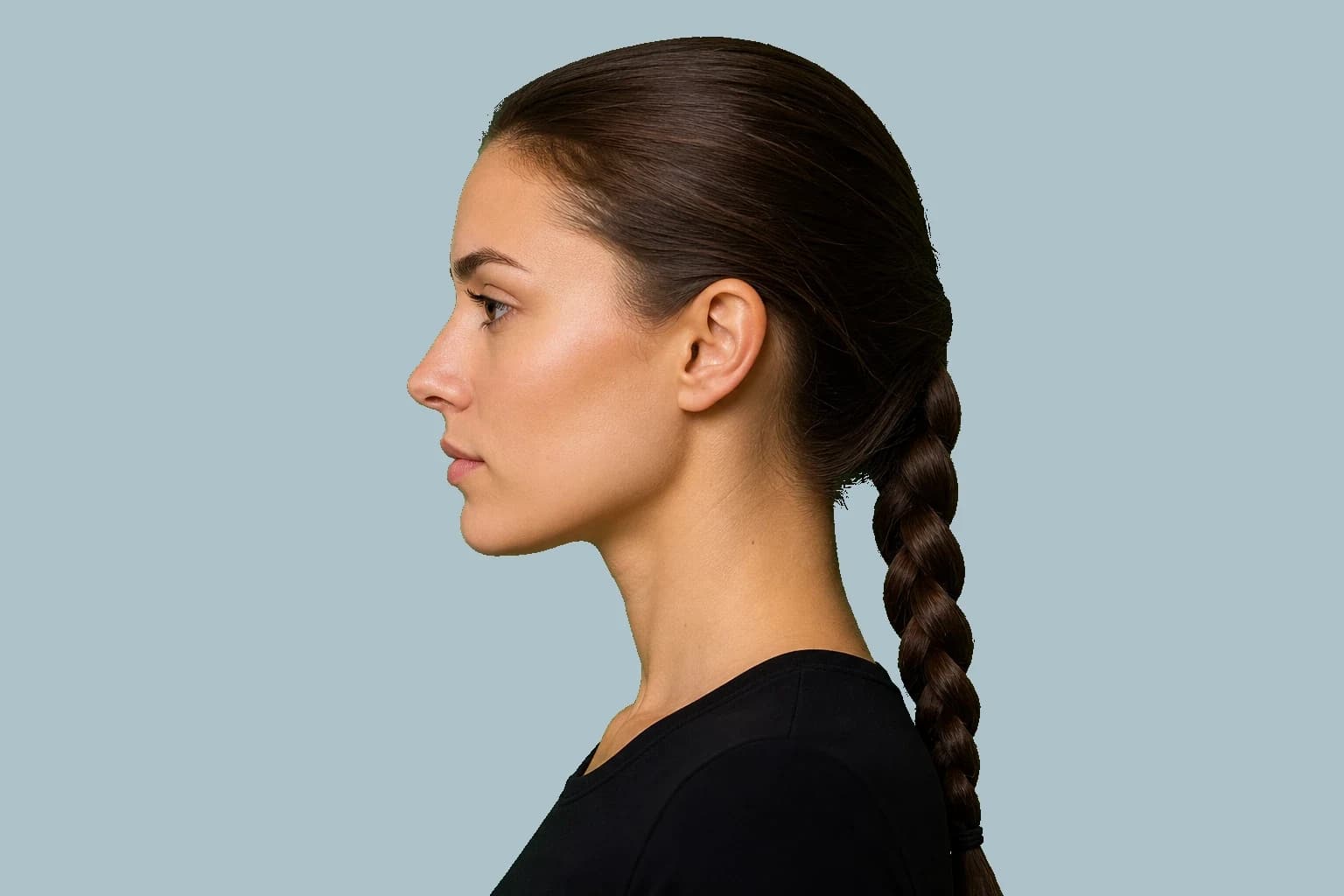
Chin height is the vertical distance from a specified mouth or chin-fold landmark to soft tissue menton, the lowest visible chin point. Starting at the lip seal includes the lower lip; starting at the labiomental fold measures a shorter segment. To express a lower-face proportion, divide that distance by the distance from subnasale beneath the nose to menton. Keep the same landmarks and head position when comparing photographs.

Landmarks
- StomionSto
- The midpoint where the relaxed upper and lower lips meet.
- Soft tissue mentonMe prime
- The lowest midline point of the visible chin.
- MentonMe
- The lowest midline point of the bony mandibular symphysis.
- Mandibular symphysis
- The central fused region of the mandible that forms the bony chin.
How is chin height measured?
Start with a frontal photograph taken with the camera level and the face relaxed. Mark soft tissue menton at the lowest midline chin contour, then mark the upper endpoint. Stomion is the centre of the lip seal; the labiomental fold is the depression between the lower lip and chin. Keep the same choice in every image.
Measure the vertical separation of those points. For a proportion, divide it by the vertical distance from subnasale, beneath the nose, to menton. A hypothetical 40-pixel chin segment within a 100-pixel lower face gives 0.40, or 40%. That calculation is an example, not a target.
An ordinary photograph has no reliable millimetre scale. A ratio removes image enlargement from the calculation, but cannot remove perspective, head tilt or uncertainty in the landmarks.
How chin height changes lower face shape
A taller measured segment gives more vertical space below the selected mouth landmark. Its appearance also depends on the width of the chin, the height of the lower lip and how far the chin projects in profile.
Compare chin width and the lower face height ratio alongside height. A change in the upper endpoint can increase the number without changing the bony chin.
What three dimensional studies show
A CT study of 419 adults found greater chin width in men, but greater chin height, area and size index in women under its skeletal definitions. The symphysis measurements did not differ significantly between sexes. The bony chin and the entire mandibular symphysis therefore should not be treated as the same measurement (PMID 32545912).
A separate 3D photographic study of 100 young adults from southern Spain measured surface landmarks and found larger male values for most linear dimensions. Its sample had normal occlusion and a defined facial pattern. Different tissues, endpoints and samples can produce different findings (PMID 31462244).
Photographs of 68 white celebrities showed larger male lower-face dimensions, but celebrity selection and photographic scaling limit how those results apply to the general population (PMID 38231202).
Why chin height can change without chin growth
The visible endpoints can shift with lip posture, dental changes and the contour of the chin pad. A photograph cannot separate these influences from a skeletal change.
For a comparison over time, record whether the lips were relaxed, whether the teeth or bite changed, and whether facial hair or swelling obscured the landmarks. Describe an observed change as a surface measurement unless another method establishes its source.
How to photograph chin height
Keep the camera at the same height and distance, with the full chin visible. Face forward without turning, raising or lowering the head. Let the lips rest naturally; forcing them together can activate the chin muscle and move the fold.
Take three photographs, resetting your position between them, and mark each independently. Record the spread of the results. A later difference within that spread is not clearly distinguishable from capture and marking error.
How Shastra reads chin height
Shastra estimates visible facial geometry from photographs. Read the chin-height output with the marked landmarks and the other lower-face measurements, particularly when the fold is difficult to identify.
A photo estimate does not establish bone size or explain a bite problem. Use it to compare visible proportions with a consistent capture method.
Name the segment before quoting it
A chin-height value should travel with its endpoint definition, denominator and photograph. Those details make the measurement reproducible and prevent a lower-lip measurement from being mistaken for bony chin height.
Continue with chin width, lower face height and the measurement directory.
Frequently Asked Questions
The vertical span from a named lower lip or labiomental landmark down to the lowest chin point, menton.
Shastra
Explore your facial proportions
Upload a front and side photo to see these measurements on your own face.

- Symmetry
- fWHR
- Canthal tilt
- Facial thirds
- Gonial angle
- E-line
- Phi ratio