Palpebral fissure length is the horizontal distance from endocanthion to exocanthion on one eye. It measures the visible eyelid opening, not eyeball diameter and not temple width. The value describes horizontal eye length, facial fifths, eye spacing, and the aperture to length ratio. The medial corner can be partly covered. The lateral corner can blur into lashes or shadow. You need a clear frontal image for each endpoint.
Landmarks
- Palpebral fissure
- The opening between the upper and lower eyelids.
- EndocanthionEn
- The inner meeting point of the upper and lower eyelids.
- ExocanthionEx
- The outer meeting point of the upper and lower eyelids.
- Palpebral fissure index
- Vertical fissure height divided by horizontal fissure length, expressed as a ratio or percentage.
- Curved lid margin length
- The traced arc along an eyelid margin, which is longer than the straight corner to corner span.
How do you measure palpebral fissure length?
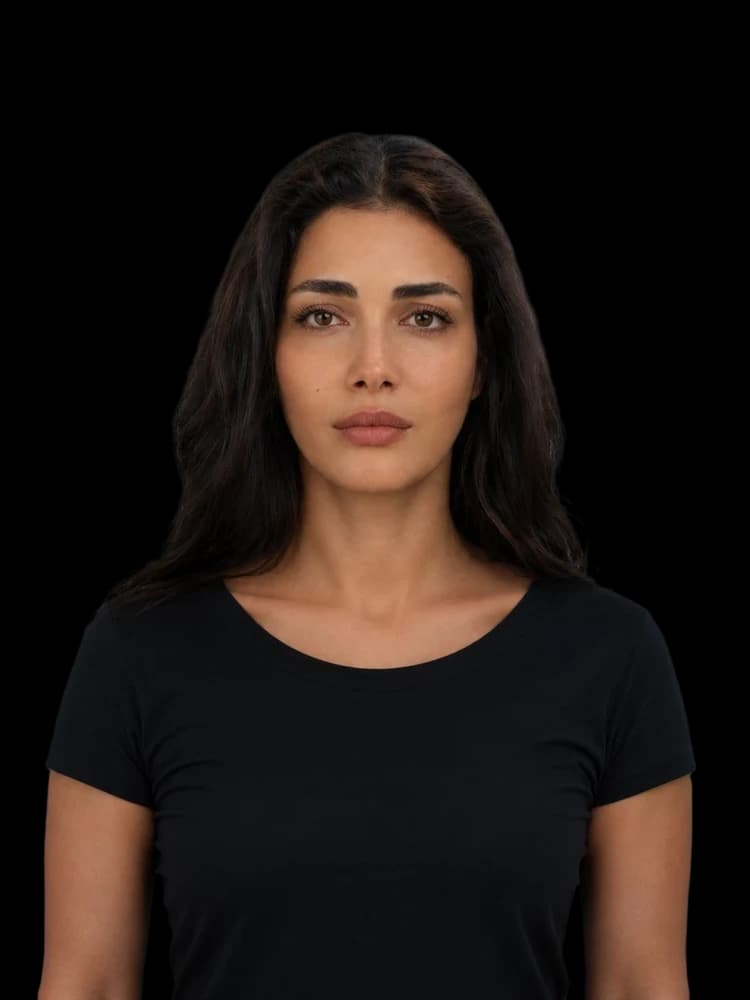
Mark endocanthion and exocanthion on one eye. Measure the straight distance between them. Repeat on the other side. Report the mean and the side difference. Do not silently pick one eye.
The direct span is not the curve length of the upper or lower lid margin. It is also not outercanthal distance, which runs from the left outer corner across both eyes to the right outer corner.
On photographs, scale the length to a stable facial reference or combine it with fissure height. Raw pixels cannot be compared across different crops.
Why horizontal length changes the eye region
Longer fissures relative to aperture height look more stretched sideways. Shorter fissures with the same height look rounder. Canthal tilt then rotates that basic shape.
Intercanthal distance decides how the two fissures sit across the face. A long eye beside a narrow central gap makes a different fifths pattern from the same eye beside a wide gap.
What adult measurements show
A Korean study reported adult mean horizontal fissure values of 27.0 millimetres in men and 26.8 millimetres in women (PMID 18349663). A South Indian adult study reported 31.08 millimetres in men and 29.90 millimetres in women (PMID 23386941).
A three dimensional orbital study found significant effects of sex, age, and their interaction on fissure length across a large sample aged 4 to 73 (PMID 19153019). Match the reference to the sample. There is no universal target.
How fissure length changes across life
Topographic eyelid analysis found that horizontal fissure length increased by about 3 millimetres from adolescence to young adulthood and then shortened by about 2.5 millimetres from middle to old age in its sample (PMID 10365046).
Korean growth data placed peak horizontal fissure growth later than peak vertical growth, between ages 17 and 19 (PMID 18349663). Match age when you compare adults.
Why longer does not mean universally better
Attractive Italian young adults had longer fissures and smaller intercanthal width than a general comparison group, alongside differences in inclination and orbital height (PMID 24857159). That is a combined pattern in one sample.
A Chinese young adult study found that fissure index, canthal index, crease height, and exocanthion angle related to ratings (PMID 26395280). Length alone did not define the entire aesthetic result.
An extremely long narrow opening, a short tall opening, and a balanced moderate opening each interact differently with sex cues, midface width, brow shape, and the orbit. Read it with the rest of the face.
How to photograph fissure length
Use a level frontal image with direct gaze, relaxed eyelids, no yaw, and soft light at both corners. Reject frames captured during a blink or squint.
Epicanthal folds can cover the exact medial corner. Lashes and temporal shadow can hide the lateral corner. If a corner is covered, mark it as uncertain. Do not guess an endpoint through an occlusion.
How Shastra reads palpebral fissure length
Shastra estimates left and right fissure length, scales them to facial and orbital width, and combines the result with aperture height, canthal tilt, intercanthal distance, and side symmetry.
Shastra uses a balanced range within the relevant sex model and capture confidence. It does not assume that the longest possible eye is the best eye.
Horizontal eye length needs vertical and spacing context
Palpebral fissure length is a clear corner to corner span when the endpoints are visible. What it looks like comes from the height to length ratio, tilt, central spacing, and facial width around it.
Measure both sides. Use a matching age and population reference. Keep eye opening separate from eyeball size.
Read it against the rest of the measurements series. Trait context: what facial dimorphism is.
Frequently Asked Questions
The straight horizontal distance from your inner eye corner to the outer eye corner.
Shastra
Explore your facial proportions
Upload a front and side photo to see these measurements on your own face.

- Symmetry
- fWHR
- Canthal tilt
- Facial thirds
- Gonial angle
- E-line
- Phi ratio