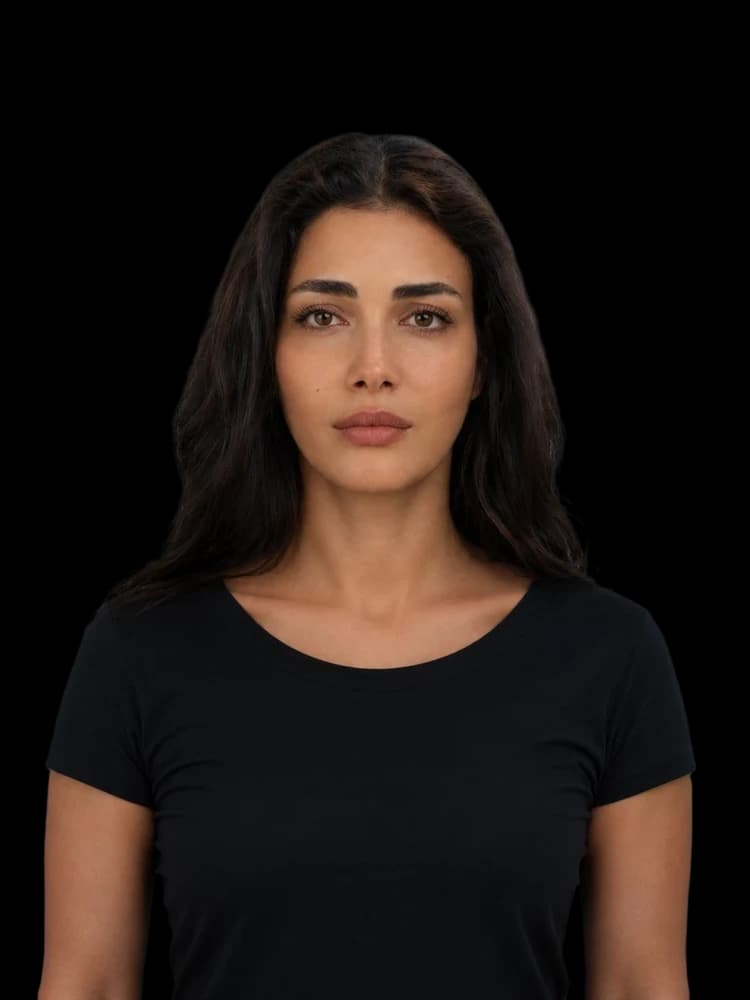
The nasofrontal angle describes the transition from forehead to nasal bridge at the nasal root. In a surface photograph, the vertex is the deepest visible root point, often called soft tissue nasion. The result depends on the forehead line and nasal line you choose. A skeletal CT measurement and a photographic tangent measurement can therefore differ substantially on the same general region.
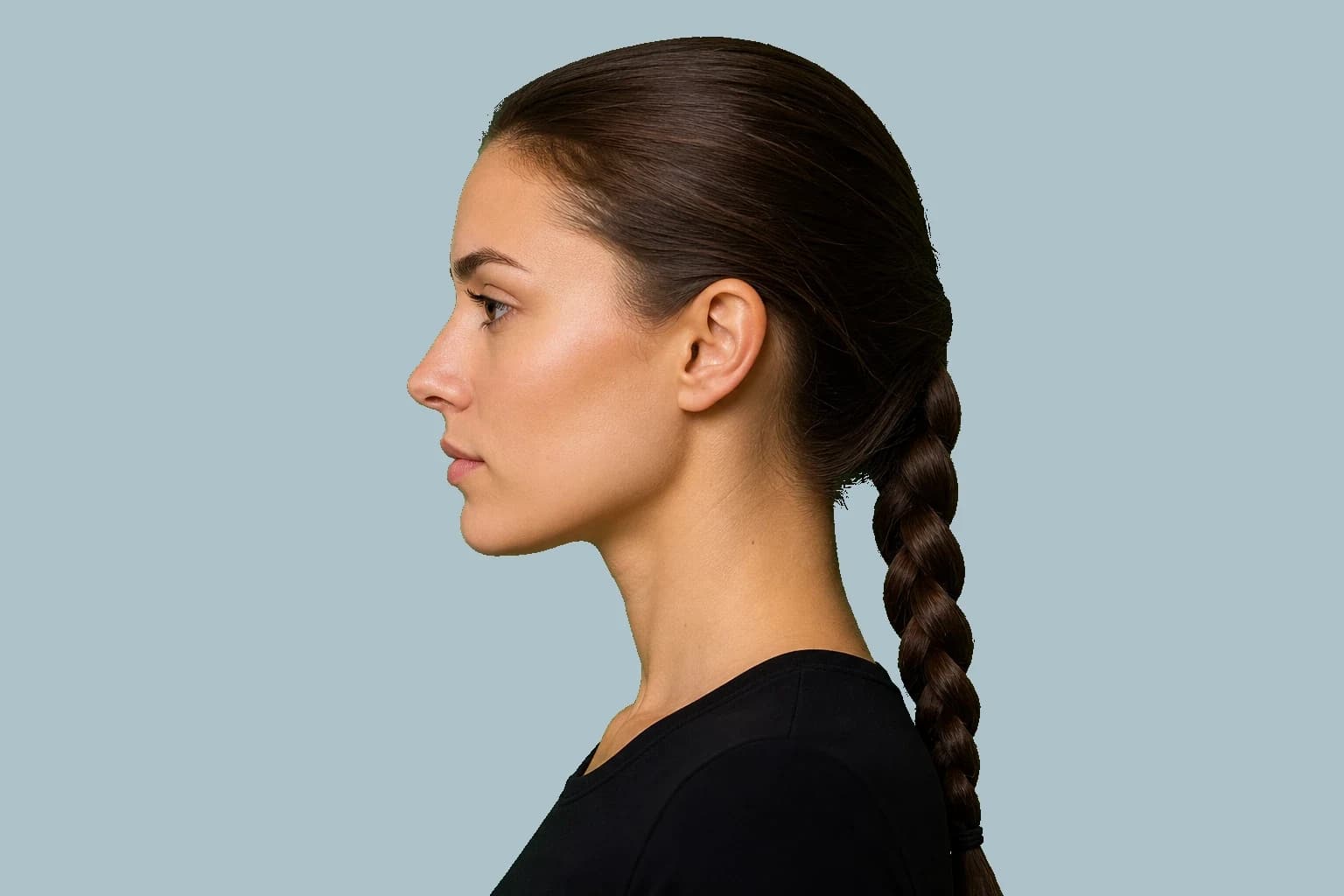
Landmarks
- GlabellaG
- The most prominent midline point of the lower forehead above the nasal root.
- NasionN
- The deepest midline point at the frontonasal junction in profile.
- Nasal dorsum
- The bridge contour extending from the nasal root toward the tip.
- Soft tissue nasion
- The visible surface depression at the root. It sits over but not exactly on skeletal nasion.
- Forehead tangent
- The fitted line used to represent forehead slope when the contour is curved.
How is the nasofrontal angle measured?
In a true side profile, locate the deepest visible point at the nasal root. Mark the forehead or glabella point and the bridge point required by your chosen method. Draw the two segments and measure the internal angle at the root.
Record whether you used a forehead tangent or a line to glabella, and whether the nasal arm follows the upper dorsum or extends to the tip. Moving the tip endpoint can change the angle even if the upper nasal root is unchanged.
Distinguish soft tissue nasion from the bony landmark at the frontonasal suture. A photograph shows the skin contour; CT can show the bone.
What counts as a small or large nasofrontal angle?
A CT study of 160 native Saudis reported means of 125.3 degrees in men and 135.6 degrees in women. The authors noted that the clinical sample was not a cross-section of the whole Saudi population (PMID 28377544).
An altered-silhouette experiment found a preferred value around 130 degrees for one idealized white male profile. That result concerns observer preferences for a particular construction, not a clinical threshold for every face (PMID 27494590).
Read a smaller or larger value relative to the same landmark method. Comparing numbers from unlike methods can create an apparent difference that is mostly measurement choice.
125.3°
Male mean in one Saudi CT sample
135.6°
Female mean in the same sample
Method sensitive
Tangent choice changes the value
Does the nasofrontal angle change with age?
Paired CT images from 48 Korean adults, separated by an average of 12 years, showed mean nasofrontal-angle increases of 3.2 degrees in men and 2.5 degrees in women, with substantial individual variation (PMID 38062715).
This was an aging study, not a trial of manual traction. It does not tell us that a person can reproduce the change with pressure or exercise.
Why sex and ancestry affect the angle
A 3D surface study of 60 Korean adults reported nasofrontal-angle means of 142 degrees in men and 147 degrees in women. Compare its surface construction and sample before setting those numbers beside CT values (PMID 17561054).
Anthropometry in 69 African-American adults also documented variation in nasal measurements and proportions. A group reference cannot determine the preferred contour of an individual (PMID 7741429).
The errors that can move the angle
Include the forehead, nose, lips and chin in a side-profile photograph. Use the visible silhouette, avoid a raised eyebrow and keep the head orientation consistent. A slight turn changes the projected root contour.
Rigidly rotating a flat image does not change an angle between the same points. Changing the three-dimensional head pose or which tangent you mark can change it. Repeat the capture and report the spread instead of excessive decimal precision.
How Shastra reads the nasofrontal angle
Shastra estimates the visible root and profile geometry. Inspect the marked vertex and nasal arm before interpreting the result.
Read nasion and radix for the anatomy and nasal tip projection for a separate component of nasal shape.
Use the angle as a relationship
Save the landmark construction with the angle. Published means can supply context when tissue, method and population match; they do not set a universal target.
Compare the supratip contour and the other guides in the measurement directory.
Frequently Asked Questions
The profile angle at nasion between the forehead or glabella segment and the nasal dorsum segment.
Shastra
Explore your facial proportions
Upload a front and side photo to see these measurements on your own face.

- Symmetry
- fWHR
- Canthal tilt
- Facial thirds
- Gonial angle
- E-line
- Phi ratio