Nasal tip projection describes how far the tip extends forward relative to a specified facial or nasal reference. It differs from nasal length and tip rotation. The Goode ratio compares a projection distance with nasal length; other methods use different lines. Name the method before comparing values, because a similar-looking fraction can represent a different construction.
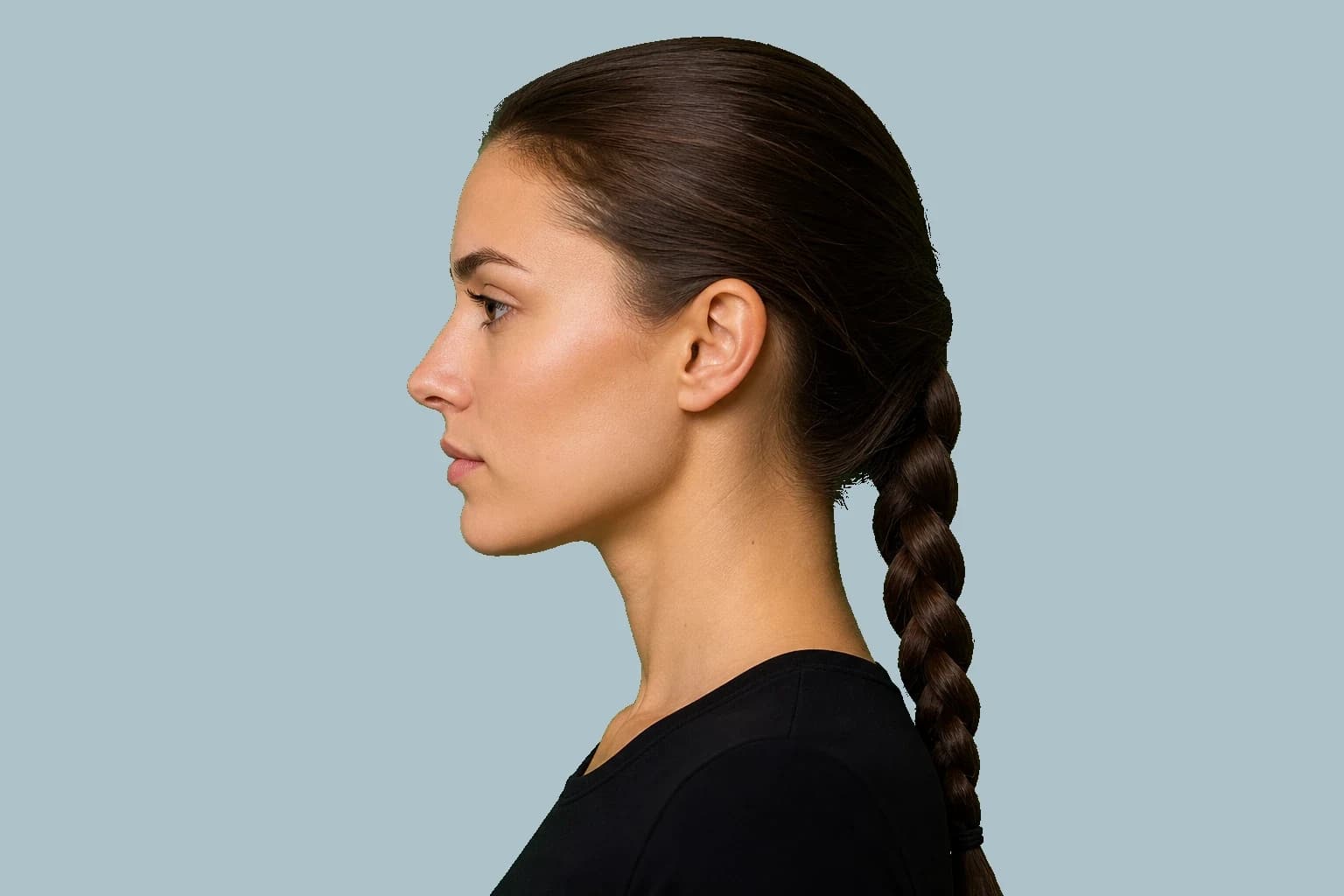
Landmarks
- Tip defining point
- The most anterior visible point of the nasal tip in profile.
- Alar facial groove
- The crease where the nostril base meets the cheek, used as a facial reference for projection.
- Goode ratio
- Tip projection divided by nasal length using the Goode landmark construction.
- Nasal length
- The profile distance from nasal root to tip under the selected method.
- Tip rotation
- The upward or downward orientation of the tip. It can change independently of projection.
How is nasal tip projection measured?
On a side profile, mark the nasal tip, nasal root and the alar-facial reference required by the chosen method. For the Goode construction, use the defined facial reference line to obtain tip projection and divide it by the defined root-to-tip nasal length. Save the traced lines with the ratio.
An illustrative projection of 30 units divided by a nasal length of 50 units gives 0.60. It is only a calculation example. Changing the reference line or denominator changes what the ratio means.
Record tip rotation separately. A tip can move upward and change its apparent projection or nasal length at the same time.
0.55 to 0.60
Classical Goode reference zone
Ratio
Projection scaled to nasal length
Side profile
Required view
What underprojection and overprojection look like
Projection is relative to the reference face and nose. A tip may look prominent beside a less projecting chin, or appear less prominent beside a higher bridge, without having moved.
Compare the nasofrontal angle, nasomental angle and facial convexity to separate the surrounding relationships.
What projection studies actually measure
A retrospective study of 173 operations found that a columellar strut did not significantly change projection or rotation when upward rotation was not intended. Surgical intent and accompanying steps mattered (PMID 32062744).
A 20-patient case series found increased upper-lip projection in 18 patients after procedures intended to increase tip projection. The small selected series supports examining adjacent features; it does not prove the same effect for every procedure (PMID 28418453).
A 106-patient comparison found different maintenance of rotation between graft techniques, but no significant between-group difference in projection change over time. Projection and rotation are separate outcomes (PMID 31373990).
Why one ratio does not fit every nose
Anthropometry in 500 young ethnic Kazakhs reported a mean Goode projection index of 57.25%. This is a sample reference under that study method, not a required proportion (PMID 27500583).
A study using nasal composites found that nasion position and dorsal contour influenced perceived nasal shape. A ratio alone leaves out those visible features (PMID 18300984).
Why selfies exaggerate nasal projection
Keep the camera well back and use framing that preserves a true side profile. Moving a camera close to the nose changes perspective; cropping the resulting image cannot undo it.
Match camera distance and head orientation across sessions. Take multiple images and redraw the reference line independently to see how much the ratio varies with placement.
How Shastra reads nasal projection
Shastra estimates visible nasal and facial geometry. Confirm the construction behind an output before comparing it with a Goode ratio from a paper.
A surface image cannot reveal cartilage support or establish the result of an operation. Use the estimate to describe the profile and inspect its components.
Projection is a ratio and a relationship
A projection report should identify the reference line, nasal length definition and ratio, with rotation listed separately. That gives more information than calling a nose overprojected from a close selfie.
Read the nasolabial-angle guide, E-line guide and measurement directory for context.
Frequently Asked Questions
The forward distance of the nasal tip from the facial plane. You commonly scale it to nasal length with the Goode ratio.
Shastra
Explore your facial proportions
Upload a front and side photo to see these measurements on your own face.

- Symmetry
- fWHR
- Canthal tilt
- Facial thirds
- Gonial angle
- E-line
- Phi ratio