The term double break angle is used here for a change in direction along the nasal dorsum toward the supratip and tip. It is not a single standardized cephalometric measurement. Before quoting an angle, define the bridge segment, the lower segment and which angle between them you report. The supratip break itself is a visible contour feature whose appearance depends on surrounding nasal shape.
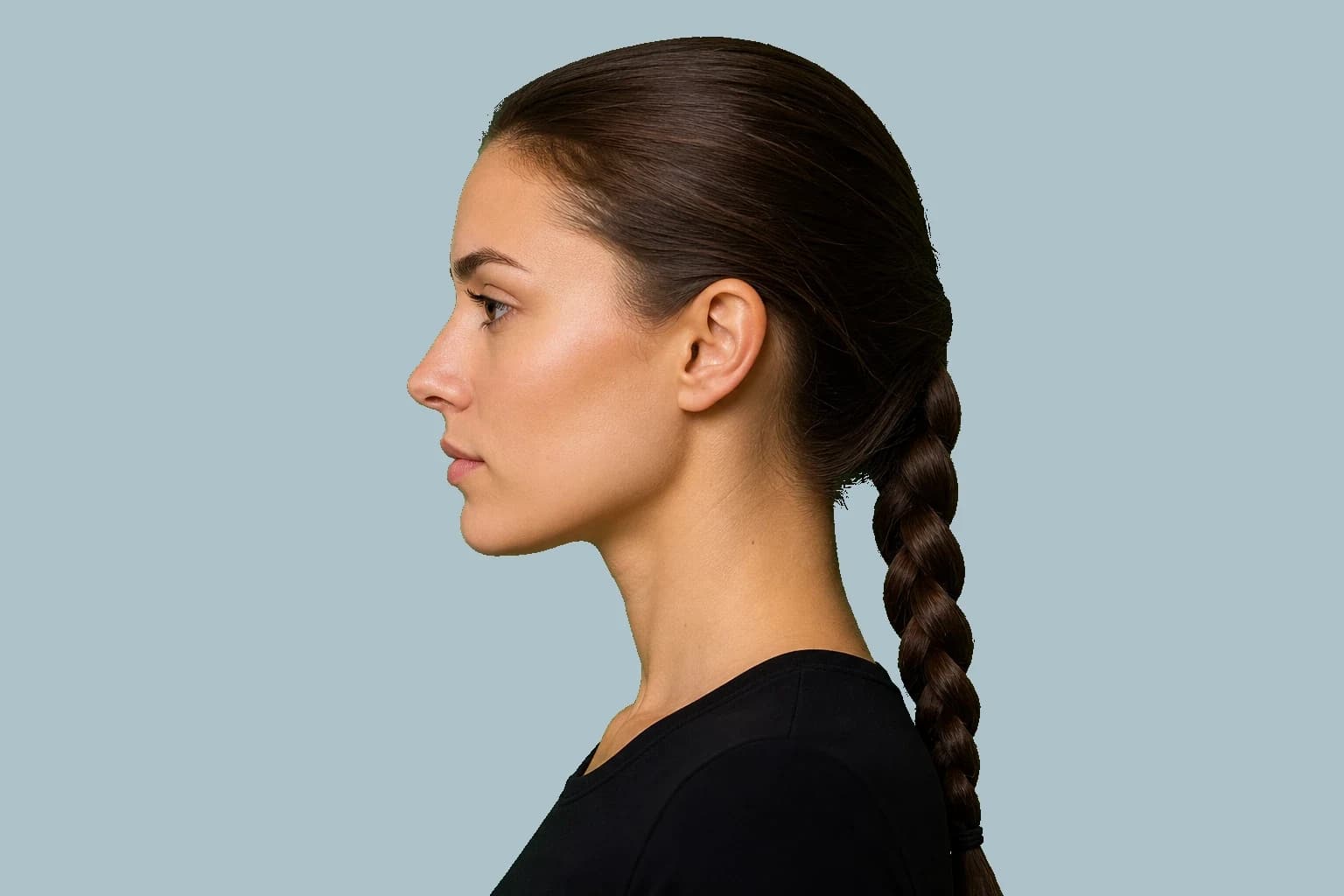
Landmarks
- Dorsum
- The bridge contour running from the nasal root toward the tip.
- Supratip
- The short region immediately above the nasal tip.
- Supratip break
- The visible change in slope that separates the dorsum from the tip complex.
- Tip defining point
- The most visually prominent point of the nasal tip in profile.
- Rhinion
- A bony landmark near the lower end of the nasal bones. It is not always the visible dorsal break.
How do you measure the double break angle?
Start with a true side-profile photograph. Identify the upper dorsal contour and the transition above the tip. Mark the interval used for each tangent rather than moving the line until a desired value appears.
Draw the upper and lower tangents and label the reported angle. Two intersecting lines define supplementary angles: 20 degrees and 160 degrees can describe the same pair of lines under different conventions. Save the construction with the value.
A curved or humped dorsum may not support one repeatable upper tangent. In that case, describe the contour and its uncertain interval instead of forcing a number.
- Capture: true side profile with even lighting.
- Trace: label the upper and lower tangent intervals.
- Convention: state which of the supplementary angles is reported.
- Compare: repeat the construction on matched images.
What does a stronger or softer break mean?
A visible supratip break separates the contour above the tip from the tip itself. Its appearance changes with dorsal shape, tip projection, tip rotation and the thickness of the covering tissue.
In a study using ten white female models and 100 raters, a subtle supratip angulation was preferred to a more marked one. The experiment compared those alternatives in that sample; it did not define an ideal angle for all noses (PMID 22421480).
Another study of nasal composites found no supratip break in its composites and described gender differences as subtle. Together, these findings argue for interpreting preferences within their specific images and populations (PMID 18300984).
What the surgical literature establishes
A retrospective series of 156 rhinoplasty patients described preserving and suturing the Pitanguy ligament to control tip and supratip shape. It reported postoperative outcomes without establishing a universal photographic angle (PMID 36988451).
An 83-patient study examined an external supratip suture approach. It concerns surgical soft-tissue control, not an exercise for changing the nasal bridge (PMID 36042029).
Anatomical work using 15 cadavers and observations in nine surgical patients showed the complex overlap of nasal bone and cartilage. A visible break cannot identify those internal structures from a photograph (PMID 25805276).
Why phone photos change the double break
Trace the outer silhouette rather than a light-to-shadow boundary on the skin. Directional light can suggest a break even when the actual profile is smooth.
Match camera distance, side orientation and expression. Moving closer to the camera changes perspective; turning slightly away from profile changes which contour is visible. Repeated captures show whether your tangent selection is stable.
- Do not use a selfie lens at arm length.
- Do not compare one smiling image with one neutral image.
- Do not infer cartilage or bone change from a lighting shadow.
- Do not compare angles traced with different tangent definitions.
How Shastra uses the double break
Shastra can help explore the visible profile. Use its marked contour as an estimate and keep the tangent definition with any comparison.
Compare the nasofrontal angle, nasal tip projection and nasolabial angle. They describe different parts of the nose and should not be substituted for this contour.
The double break is a contour, not a universal ideal
A reproducible description is more informative than a precise-looking number with no construction. Record the contour, tangent intervals and angle convention, then compare like with like.
Use the measurement directory to place the supratip within the full facial profile. Preference studies describe their raters and images; surgical studies describe their procedures and patients.
Frequently Asked Questions
The angle between a tangent along your upper nasal bridge and a second tangent along the lower dorsum or supratip. It describes how the bridge changes direction before the tip.
Shastra
Explore your facial proportions
Upload a front and side photo to see these measurements on your own face.
- Symmetry
- fWHR
- Canthal tilt
- Facial thirds
- Gonial angle
- E-line
- Phi ratio