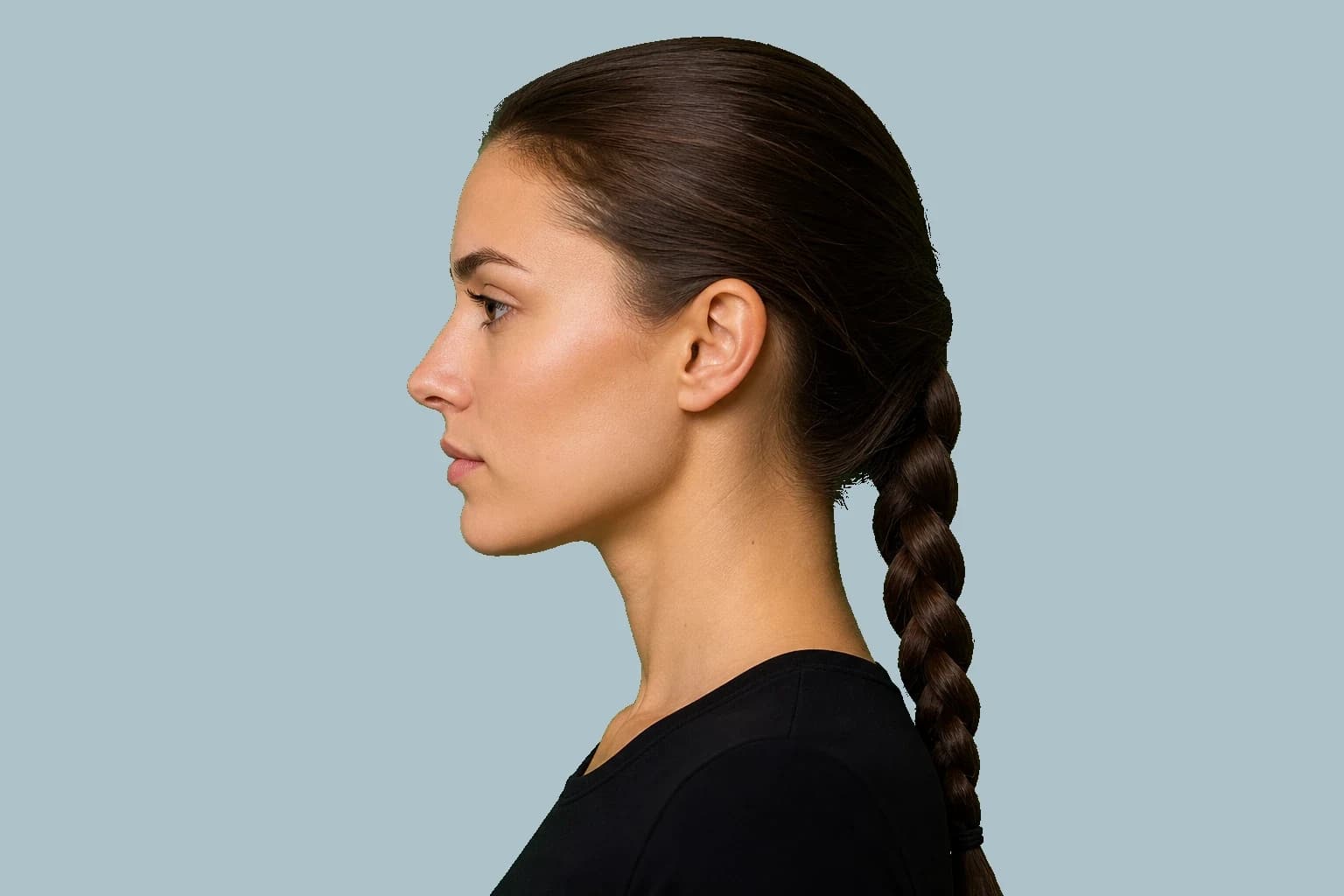
The Ricketts E line connects the nasal tip to soft tissue pogonion, the most forward visible point of the chin. Upper- and lower-lip positions are measured as perpendicular distances from that line. State the sign convention: this guide uses negative for behind the line and positive for in front. The reference moves when the nose or chin changes, even if the lips do not.
Landmarks
- E line
- The profile line from pronasale at the nasal tip to soft tissue pogonion at the chin.
- PronasalePrn
- The most anterior point of the nasal tip.
- Soft tissue pogonionPg prime
- The most anterior point of the soft tissue chin.
- Labrale superiusLs
- The most anterior point of the upper lip vermilion.
- Labrale inferiusLi
- The most anterior point of the lower lip vermilion.
How is the E line measured?
Mark pronasale at the tip of the nose and soft tissue pogonion at the chin. Draw the straight line between them. Mark the most forward vermilion point of each lip and measure its shortest perpendicular distance to the line.
Label each result with the sign convention. A point behind the line is negative in this guide. For a calibrated image, a hypothetical upper-lip distance of minus 3 mm means the lip lies 3 mm behind the line; it is not a recommendation.
The often-quoted minus 4 mm upper-lip and minus 2 mm lower-lip references belong to a historical framework. Without image calibration, report pixels or a clearly named normalized distance rather than pretending to know millimetres.
Nose to chin
Endpoints of the E line
About minus 4 mm
Classical upper lip reference
About minus 2 mm
Classical lower lip reference
Why E line values vary
A longitudinal study of 27 young adults followed for an average of 7.2 years found changes in nasal depth and other profile features. The reference nose-to-chin geometry can change through adulthood (PMID 18575305).
An experiment with one altered Black female profile and 100 Black and white evaluators found no statistically significant preference differences by evaluator race, sex or educational background. That finding does not support claiming this study demonstrated racial differences in preferences (PMID 23957665).
What preference studies show
Another experiment used photographs of one Chinese boy and one girl, altered in presentation and lip position. The preferred lip positions differed between the two depicted faces and some judge groups. Two faces cannot establish population-wide lip targets (PMID 27051277).
An E-line distance is a description of geometry. Preference results depend on the stimulus images and people rating them; they do not establish a biological optimum.
Why dental and denture support changes the line
A study of five complete-denture wearers varied lip support with experimental record blocks. The resulting profile changes included the relation of the lips to the E plane. The small specialized sample illustrates dental-support effects without predicting them for all readers (PMID 16457669).
When comparing images, check whether the tip or chin endpoint moved as well as whether the lip moved. A rotated reference line can change the signed distance without a corresponding change in lip tissue.
How to photograph E line position
Use a true side profile with the entire nasal tip and chin visible. Let the lips rest naturally. A smile or a pursed lip changes the contour being measured.
Match camera distance and head orientation, then repeat the tracing. Keep a scale if millimetres matter; otherwise use a consistent normalized measure and name its denominator.
How Shastra reads the E line
Shastra estimates visible lip, nose and chin geometry. Inspect both endpoints and the lip landmarks before interpreting the E-line output.
Read nasal tip projection, nasolabial angle and facial convexity for the component relationships.
A useful line with moving endpoints
The E line is quick to construct, but its endpoints belong to the nose and chin. A good comparison records those endpoints, both lip distances, the sign convention and the image scale.
Use the measurement directory to compare the rest of the profile. A historical reference distance is context, not a reason on its own to change the lips.
Frequently Asked Questions
A side profile line from the nasal tip to soft tissue pogonion on the chin. You measure lip positions perpendicular to it.
Shastra
Explore your facial proportions
Upload a front and side photo to see these measurements on your own face.

- Symmetry
- fWHR
- Canthal tilt
- Facial thirds
- Gonial angle
- E-line
- Phi ratio